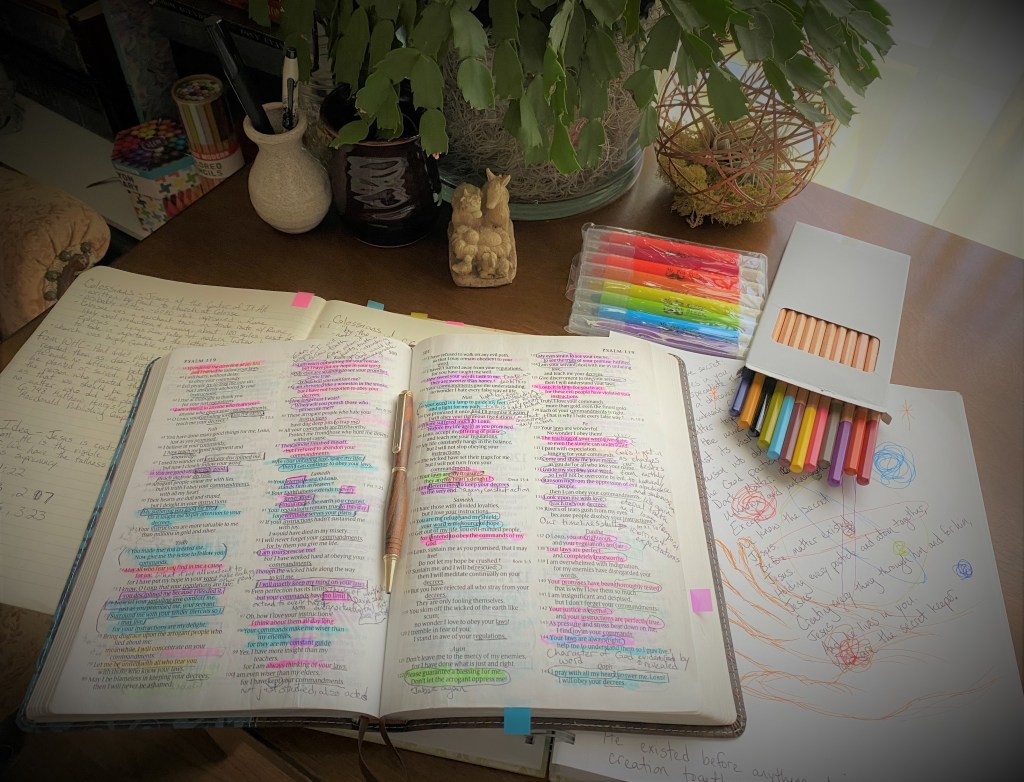
You can absolutely just dive in and start reading the Bible. That’s a great way to start building a practice of learning the text. Once you dive in, you may run into things that feel old and outdated or long lists of genealogies or laws that seem to make no sense or stories that just sound weird. You may have a million questions and wonder just what you’ve gotten yourself into.
That’s perfectly normal.
It will be tempting to give up studying for yourself and just let other people who do study tell you what to think or to think the Bible can’t possibly still be relevant today. But don’t give up just yet. Try these things first.
Prepare for study by praying and asking God to reveal himself to you as you read the Bible. Ask him to give you fresh wisdom about how to apply the text to your life and faith. Ask him to open your heart and your mind to what he has to say to you.
Read a translation that’s comfortable for you. If you prefer a particular version, use that one. If you don’t have a preference or don’t know what to look for in a Bible translation, look at a familiar passage online or in an app that offers multiple translations, and choose the version that’s easiest for you to read and understand. Many churches have a preferred translation, and it helps to do corporate Bible study using a single version, but there is no such mandate in the Bible. From my time in college studying Hebrew, I love how the NKJV translates poetry, but I love reading and teaching from the NLT for its plain language. When a text is really hard to understand, I’ll read it in multiple translations because each of them will bring a different speech pattern and translate words a little differently, and that can all add more detail and nuance to my understanding. Several apps and websites provide Hebrew and Greek text alongside the English translation with definitions of the words and the ability to see where else the same word was used in the text.
Try reading commentaries and Bible study books or listening to podcasts or other resources when you have time to dig deeper. A really important thing to note about commentaries and other study resource material is that they are the product of someone else’s study, so they are not the word of God. No commentary is perfect or a complete interpretation of the Bible, but they are excellent resources for deeper understanding and new insights. As you grow more comfortable with finding and using extra study resources, try expanding to resources outside your usual denominational sources. Seeing the text from a different perspective can be extremely helpful, and it’s a good way to practice discernment as you compare resources and discuss the material with others.
Take notes or doodle as you read. Note words you want to look up, questions you have, patterns you’ve seen before, phrases that stick out… anything you want to think more about. I like to sketch out things that are described with great visual or directional detail or making timelines or charts for details that feel tedious (like genealogies) to keep my brain engaged with the material.
Ask questions and imagine you’re a detective looking for clues and connections. Why were certain details included or left out? Use the question words we all learned in school to research the original cultural context and the historical setting – who, what, when, where, why, and how are a fantastic place to start. Think of the Bible as a single, unified story. How does the passage you are reading fit in with the big picture? Study the details of a particular passage and then zoom out and ask yourself a few questions about what you read. Ask yourself what the passage reveals about God, what the passage reveals about humanity, and what the passage reveals about you and how you relate to God and to others.
Ask even more questions. If we’re honest, there are things in the Bible that just sound weird. Don’t be afraid of the weird questions. Don’t be afraid to ask what you think is a stupid question. Don’t be afraid to ask hard questions you might be a little afraid to learn the answers to. Questions are good, and there is no question too big for God – if there is, there’s a problem with our understanding or our doctrine or our application. I firmly believe our God is infinite enough to handle anything we mere humans can throw at him, but sometimes our human faith is too small to accept answers we don’t understand or don’t like.
Look for repeated patterns and phrases- the Bible is FULL of them. I have been known to say I could teach the whole Bible using Genesis 1-3 because every element of God’s story is present in those three chapters and repeats a gazillion times throughout the rest of the text. I have also been known to say that everything that follows the Torah is pretty much just commentary on the Torah, and arguably everything Jesus is quoted as saying in Matthew’s gospel is a reference to one or more Old Testament passages. Those connections are intentional so we will remember the reference text and use it as a point of comparison or context to understand the passage we’re reading. No surprise Jesus would be a master of this teaching method, and the prophets weren’t too shabby at it, either.
Try a different input. If you exclusively read a print copy, try listening for a while instead or read the text out loud. If you never venture outside your favorite translation, switch it up and read a different one. Read from the Adventure Bible or the Storybook Bible.
Talk about what you’re studying with someone else. Bounce your questions and observations and ideas off a teacher or a friend who’s also studying the Bible. We learn best from each other and in a community that can help us know we’re not heading down a wrong path.
Do things that make you spend time dwelling on the text. Memorize verses and longer passages. Write verses out by hand. Draw pictures of verses and stories. Dance or act out the text or put hand motions to key words for memory verses. Rewrite a verse or chapter in your own words. Make a brainstorming map of the main point and the supoorting details.
There’s no one right way to study the Bible, so try different techniques and see what works best for you. And don’t let anyone else’s work intimidate you. The point is to grow in your understanding and wisdom and faith. Not everyone is meant to be a scholar parsing fine details of ancient Hebrew or Greek. Not everyone is meant to write their own commentary or teach the masses, but we’re all called to hide God’s word in our hearts so it can guide our steps.
 Potluck at the Park
Leave a comment