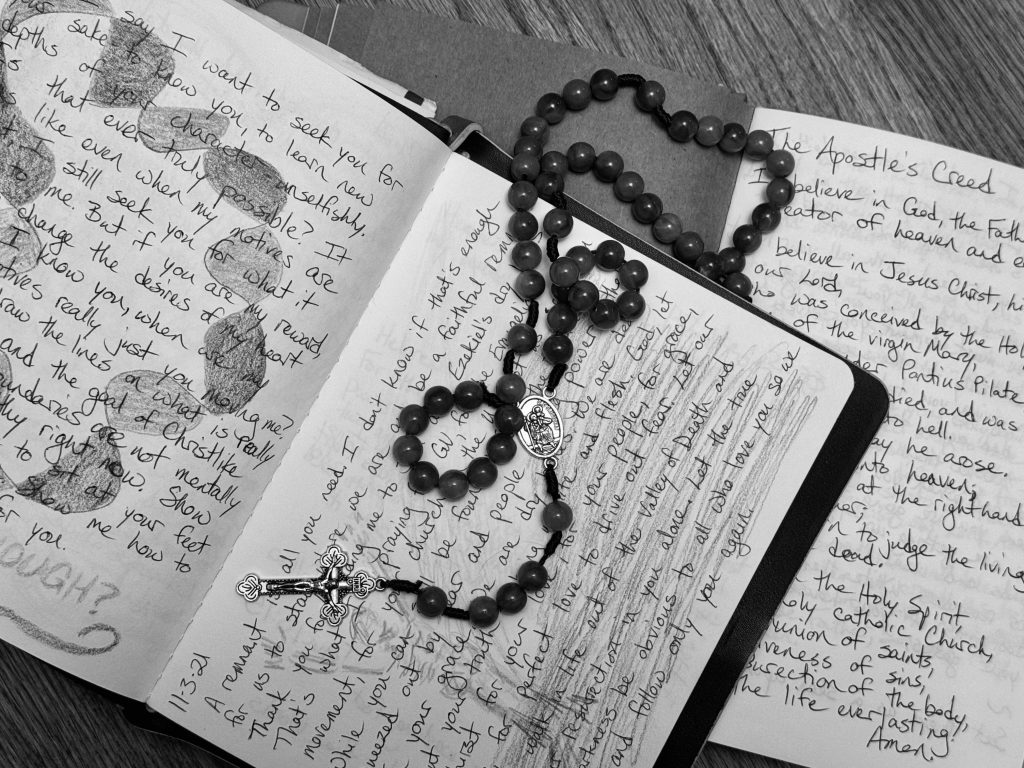
Prayer is simply talking to and listening to God. That’s it. There are no magic words or formulas for “effective” prayer or to make God hear you. He knows you, he created you, and he will always hear you, even when you don’t have any words at all.
It’s easy to think that since God knows our thoughts and our hearts that prayer isn’t really necessary- he knows what you’re going to say anyway, so what’s the point? Prayer is one way we establish communion with God. Just as conversation and open communication are important in all our relationships with family and friends and coworkers, prayer as conversation is important to our relationship with God. Does that mean prayer will sound and feel like every other conversation we have? Honestly and bluntly, probably not. There are surely people who experience this kind of prayer life, but I have never been one of those people. Most of the people I know don’t hear God speak to them audibly or even in words. I also have ADHD, so my prayers that aren’t written or drawn tend to sound like me telling a story to a friend with so many side quest bits I lose my train of thought; listening and meditation are also tough because there’s never a moment in my head without images or narration bumbling around.
The good news is, even when we don’t know what to pray or how to pray, the Bible tells us the Holy Spirit prays for us (Romans 8:26-27). The Bible also consistently teaches us that our consistency and intent matter most. HOW we pray matters very little; THAT we pray is most important; think function over form. (Matthew 6:1-18, Matthew 7:7-11, Luke 11, 1 Thessalonians 5:16-18, James 1)
Even if the form of our prayers isn’t what counts, it can help to have some framework to work from. The main elements are talking and listening. Prayers in the Bible often express gratitude and praise, ask for God’s forgiveness, ask God for help, and vent pain and anger and frustration. The Psalms are a great place to start if you’re new to prayer. When I was a kid, we learned the acronym CATS to help us remember important things prayers can include: Confession (tell God about your sin and ask him to forgive you), Adoration (praise God), Thanksgiving (speak gratitude), Supplication (ask for help). The Catholic practice of praying the rosary moves through a similar pattern and repeats liturgies (written and commonly used prayers) as a method of meditation or listening. Many people use their body posture, like kneeling or Quaker centering down (often called “palms up, palms down”), as a tool to focus and express humility before God. You can pray anywhere, any time, any way- just be honest and keep practicing.
Things that get in the way of developing a consistent prayer practice are often not making time; not knowing what to say or if we’re doing it right; it feels like a duty or obligation rather than a conversation we desire to have; if (when is more accurate) God doesn’t answer our prayer the way we wanted him to we get discouraged or angry. Those are all understandable obstacles, but the Bible doesn’t let us off the hook because it feels weird or we don’t feel like it. The Psalms are full of examples of expressing anger and sadness and frustration at God for not answering their prayers the way they wanted him to, and I firmly believe those exist in the Bible to show us that transparent honesty in prayer is the most important human element of prayer. I also love that almost all of those prayers end with recognition of God’s character and trustworthiness.
Some ways to pray that aren’t sitting still and quiet:
Journal
Recite liturgies out loud
Go outside and listen
Doodle
Make notecards or lists
Dance it out
Try breathing meditation exercises
Take a walk and pray for the community around you
Pray while you’re driving
Pray while you’re cleaning
Sing a psalm
 Potluck at the Park
Leave a comment